020 3793 7323
Your installation is covered long after the scaffolding comes down. Call the team direct, or log a request below and one of our support engineers will pick it up, work out what's happening and come back to you with clear guidance and practical support to get your system running smoothly again as quickly as possible
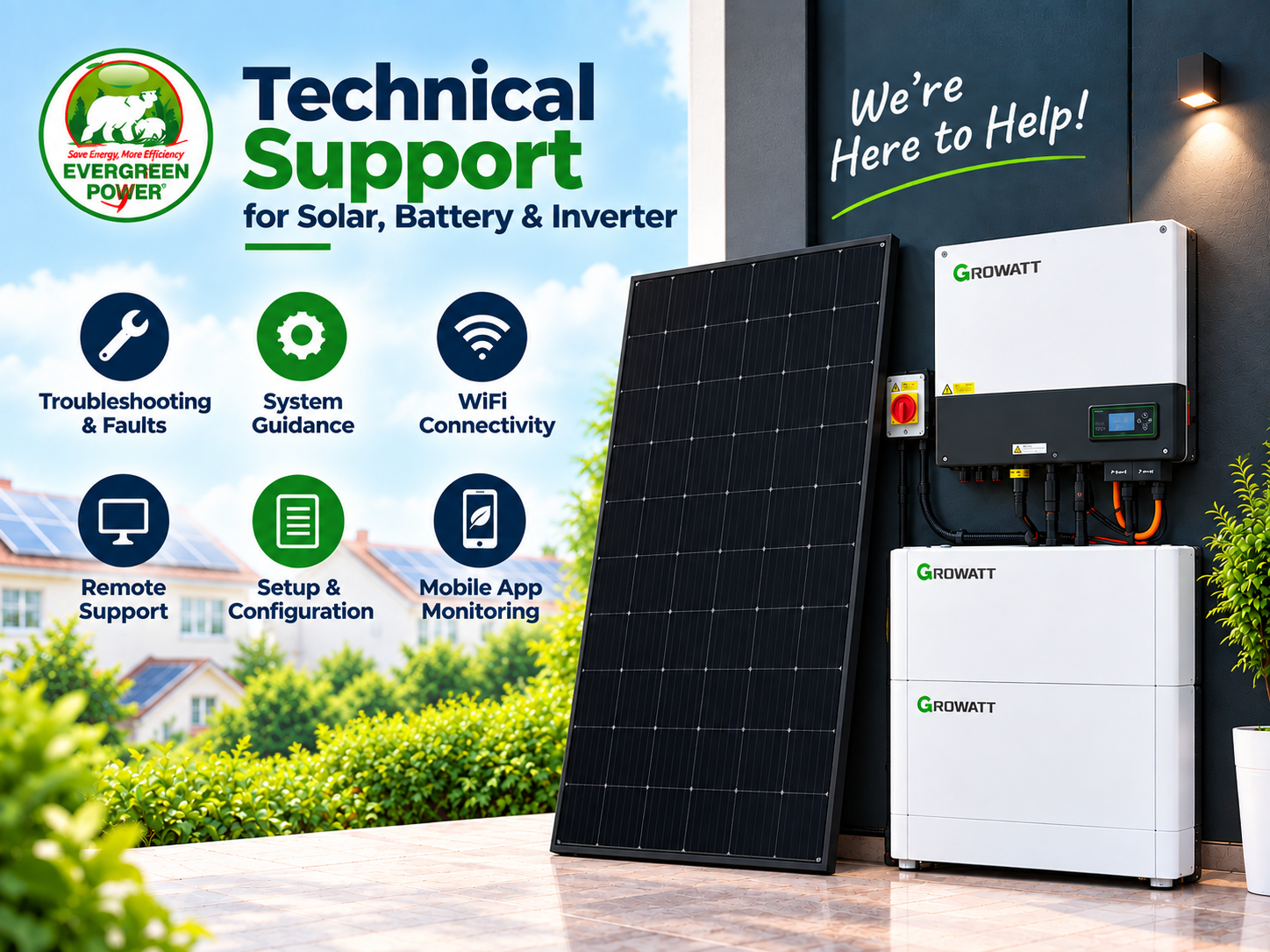
Faults, error codes, no generation, monitoring and app problems.
02037937318 Mon–Fri, 9am–5pmFor non-urgent technical queries, faults, and general support.
support@evergreenpoweruk.com Mon–Fri, 9am–5pmOpen, track and manage support tickets for your Evergreen Power UK solar PV and battery installation.
Click below to access Evergreen Power Helpdesk and log in your support ticket. You’ll get a reference number by email, and an engineer will get back to you.
Thanks — we've sent it to our engineers and emailed you a copy. Quote this reference if you call us:
EPUK-20260906-A3F91Photos help a lot. If you have a picture of the inverter screen, the error code or the affected area, reply to the confirmation email and attach them.
It saves a call back and often lets an engineer solve it there and then.
It's how we find your job file, install date and equipment list in seconds.
Photograph any error code or warning light. Most faults are identified from that alone.
Have it open if you can, and note the last date it recorded generation.
New appliance, power cut, new broadband router, roof or building work — all common causes.
Quite a few things people call about can be sorted in a couple of minutes at home.
Nine times out of ten this is the monitoring, not the system. Check the inverter display itself — if it's showing normal output, your panels are fine and it's the data connection that's dropped.
Most commonly that's a changed broadband router or Wi‑Fi password. Reconnecting the inverter to the new network usually restores it. If the inverter screen is blank or showing a fault, log a request below.
Photograph the screen and note the exact code, then send it to us. Codes are manufacturer specific and tell an engineer straight away whether it's a grid issue, an isolation fault or a hardware failure.
Some faults clear on their own after a grid disturbance. If it's still there after an hour, get in touch rather than repeatedly resetting it.
Compare the same month against the same month last year rather than against summer. UK output in December is typically a small fraction of June, and that's completely normal.
If a like‑for‑like month is well down, the usual causes are new shading from growing trees or a nearby building, heavy soiling or moss, or one string having dropped out. Send us the figures and we'll compare them against your commissioning data.
Check the operating mode first. Batteries are usually set to self‑consumption, so they charge from surplus solar rather than the grid. On a dull day there may be no surplus to store.
Also check whether a reserve level or a timed charging window has been set in the app — a reserve stops the battery discharging below a set percentage. If the settings look right and behaviour has changed suddenly, log a request.
Switch off the AC isolator first, then the DC isolator, then the inverter switch if it has one. Turn them back on in the reverse order and give the inverter a few minutes to reconnect to the grid.
Never open the inverter casing or work on the DC side yourself — the panels are live whenever there's daylight on them.
Your system carries several separate warranties: a workmanship warranty from us, and manufacturer warranties on the panels, inverter and battery, each with their own term. Your handover pack lists the exact cover for your installation.
If you think something is a warranty failure, log a request with the make, model and what's happening. We handle the manufacturer claim on your behalf.
We keep a copy of everything. Send us the installation postcode and the name the job was booked under and we'll email your MCS certificate, DNO notification and warranty documents back to you.
These are the documents your energy supplier will ask for when you apply for an export tariff, and conveyancers ask for when you sell the property.
Payments come through the Smart Export Guarantee, and you apply directly to an energy supplier — it doesn't have to be the one that supplies your electricity, and rates vary, so it's worth comparing.
You'll need your MCS certificate and a smart meter capable of half‑hourly export readings. Ask us if you need your paperwork resent.
UK rainfall keeps most arrays reasonably clean. Low‑pitch roofs, coastal and rural sites, and anywhere under trees tend to build up moss and soiling that does cost you output.
We offer cleaning, bird proofing and system health checks. Ask for a quote through the form and tell us your roof type and storey height.
Most solar systems can have storage added later, though it depends on your existing inverter — sometimes a hybrid inverter or an AC‑coupled battery is needed. Send us your inverter make and model and we'll tell you what fits.
Systems generally stay with the property when you sell. If you're taking one with you, that's a full removal and reinstall with new paperwork, so talk to us early.