 020 3793 7323



Do Solar Panels Work in the UK? The 2026 Guide to Performance & Savings
Short answer: yes, solar panels work very well in the UK. They generate electricity from *daylight*, not heat or direct sunshine, so they produce power even on cloudy, overcast British days. Germany – a country with a climate and latitude similar to much of the UK – has long been one of the world’s largest solar markets. If it works in Hamburg, it works in Manchester.
Let’s clear up the myths and show you the real numbers.
The myth: “It’s too cloudy in Britain for solar”
This is the single most common thing we hear, and it’s based on a misunderstanding of how panels work.
Solar panels (photovoltaic, or “PV”, panels) convert light into electricity. They don’t need a blazing Mediterranean sky – they respond to the brightness of daylight, which is present even under cloud. On an overcast day a panel might produce 25–35% of its peak output, which is reduced, certainly, but far from zero. Across a full British year, those daylight hours add up to a serious amount of free electricity.
In fact, panels are more efficient in cooler temperatures. Extreme heat slightly reduces their performance, so a bright, crisp British spring day can be near-ideal generating weather.
How Much Electricity do Solar Panels actually Generate in the UK?
A typical, well-positioned domestic solar system in the UK generates roughly 900–1,000 kWh per year for every kWp installed. Here’s what that looks like for common system sizes
| System size | Typical roof | Estimated annual generation |
| 3.5 kWp | Smaller home, ~9 panels | ~3,000 – 3,300 kWh |
| 4.5 kWp | Average 3-bed home, ~11–12 panels | ~3,800 – 4,300 kWh |
| 6 kWp | Larger home, ~15 panels | ~5,000 – 5,700 kWh |
For context, the average UK household uses somewhere around 2,700–3,500 kWh of electricity a year. So a well-sized system can generate as much electricity over a year as a typical home consumes – though the timing of generation versus use is the key thing to manage (which is exactly where a battery helps).
Figures depend on roof orientation, pitch, shading and your location. South-facing is best, but east–west splits work well too. We model your specific roof before quoting.
Do solar panels work in winter?
Yes – just less than in summer. Generation follows daylight, so expect:
- Summer (May–Aug): the lion’s share of your annual generation, with long days frequently producing a surplus.
- Spring & autumn: strong, useful output.
- Winter (Nov–Jan): the lowest output – perhaps 25–35% of peak months – but still a real contribution that offsets your daytime usage.
This seasonal pattern is exactly why so many UK homeowners pair panels with a battery and a smart time-of-use tariff: store cheap or free energy when it’s abundant, draw on it when it isn’t, all year round.
Do solar panels work on north-facing or shaded roofs?
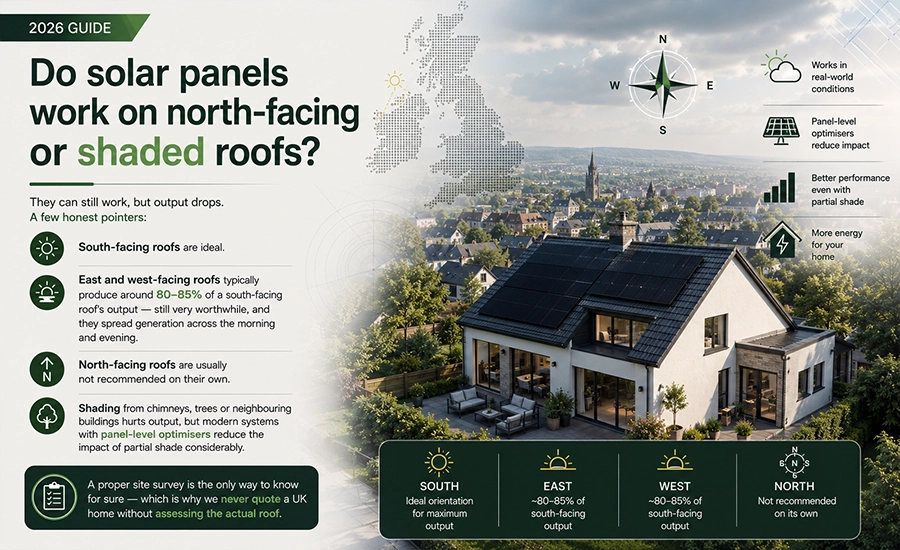
They can still work, but output drops. A few honest pointers:
- South-facing roofs are ideal.
- East and west-facing roofs typically produce around 80–85% of a south-facing roof’s output – still very worthwhile, and they spread generation across the morning and evening.
- North-facing roofs are usually not recommended on their own.
- Shading from chimneys, trees or neighbouring buildings hurts output, but modern
A proper site survey is the only way to know for sure – which is why we never quote a UK home without assessing the actual roof.
Are solar panels worth it in the UK in 2026?
For most suitable homes, yes. The case is stronger now than ever for three reasons:
- High, volatile grid electricity prices mean every unit you generate yourself is worth more.
- The Smart Export Guarantee (SEG) pays you for surplus electricity you export to the grid.
- No VAT on residential solar in the UK currently makes installation cheaper (a government measure designed to encourage uptake – worth confirming as policy can change).
A typical 4–4.5 kWp system with battery costs in the region of £7,000–£10,000 installed in 2026 and can cut a household’s grid electricity bill substantially, with payback commonly in the 7–10 year range – against panels that carry 25-year-plus performance warranties. That’s potentially a decade or more of near-free electricity after payback. For context, our flagship all-in Solar panels package Corydon– 10 × 465W panels (4.65 kWp), 10.24 kWh of battery storage and a hybrid inverter – is £7,995 fully installed, paperwork and warranties included.
What about maintenance?
Very little. Solar panels have no moving parts. UK rain keeps them reasonably clean, and beyond an occasional check and the odd inverter replacement over their lifespan, they’re close to fit-and-forget. Most performance warranties guarantee around 85–90% output even after 25 years.
The honest caveats
We believe in straight talk, so here’s when solar is less compelling:
- A heavily shaded roof with no good aspect.
- A north-facing-only roof with no alternative.
If your home falls into these categories, we’ll say so. We’d rather lose a sale than fit a system that won’t deliver.
How Evergreen Power UK makes sure it works for you
We’re MCS-certified and accredited by HIES, TrustMark, NAPIT and ePVS – as well as a Tesla Certified Installer and PAS 2030:2019 approved. That’s what makes your system eligible for SEG payments, keeps it to recognised UK consumer-protection standards, and backs your installation with proper, insurance-backed guarantees. Before we quote, we:
- Survey your actual roof – orientation, pitch, shading and structure.
- Model your real generation and savings, not a sales-brochure best case.
- Right-size the system to your home and habits and advise whether a battery makes sense.
- Install with our own in house engineers and handle the grid paperwork (DNO/G99) for you.
Frequently asked questions:
Do solar panels work in the UK’s cloudy weather?
Yes. Solar panels uk generate electricity from daylight, not heat, so they produce power even under cloud – typically 25–35% of peak output on overcast days. Across a full year, the UK gets more than enough daylight to make solar genuinely worthwhile.
How much electricity do solar panels generate in the UK?
A typical UK system produces around 900–1,000 kWh per year for each kWp installed. An average 4.5 kWp home system generates roughly 3,800–4,300 kWh a year – close to what a typical household uses.
Do solar panels work in winter in the UK?
Yes, though output is lower, often 25–35% of peak summer months. They still make a useful contribution and pairing them with a battery and smart tariff keeps savings flowing year-round.
Are solar panels worth it in the UK in 2026?
For most suitable homes, yes. With high grid prices, SEG export payments and no VAT on residential solar payback is commonly 7–10 years against a 25-year-plus panel lifespan.
Do solar panels work on cloudy or rainy days?
Yes. They produce reduced output under cloud and rain rather than stopping entirely. Rain also has the benefit of helping keep the panels clean.
Will solar panels work on an east or west-facing roof?
Yes. East and west-facing roofs typically generate around 80–85% of a south-facing roof’s output and spread that generation across the day, which can suit household usage well.
Curious what your roof could produce?
Get an accurate solar assessment from Evergreen Power UK. We’ll model your home’s real generation and savings and tell you honestly whether solar stacks up for you.
Book a free solar assessment →
Written by: Kyler Walter

- Kyler Walter is a passionate advocate for renewable energy and sustainable living. As a leading voice at Evergreen Power UK, he specializes in solar energy solutions and has played a vital role in promoting innovative, eco-conscious technologies across the UK.
Latest entries
 SolarJuly 15, 2026Do Solar Panels Work in the UK? Yes – Here’s the Proof (2026 Guide)
 SolarJuly 1, 2026How Many Solar Panels Do I Need for My Home? (UK 2026 Guide)
 SolarJune 18, 2026How Much Do Solar Panels Cost in the UK 2026? A Clear, No-Nonsense Price Guide
 Solar BatteriesJune 2, 2026Tesla Powerwall 3: An Honest Look at Whether It’s Worth It for UK Homes in 2026
