 020 3793 7323



How Many Solar Panels Do I Need for My Home in the UK? 2026 Calculator & Guide
Installing solar panels in the UK: Most UK homes need 8 to 14 solar panels – roughly a 3.5 kWp to 6 kWp system. A typical 3-bedroom household lands around 10 panels (about 4.5 kWp), which is why our Solar panel package uk is built around exactly that: ten 465W panels (4.65 kWp) plus 10.24 kWh of battery storage, £7,995 fully installed. The right number for your home depends on three things: how much electricity you use, how much roof you have, and your budget.
Here’s how to work it out properly.
The three things that decide how many panels you need
Forget one-size-fits-all rules. Your ideal system size comes down to
- Your electricity usage — the more you use, the more generation is worth fitting.
- Your roof — its size, direction and any shading cap how many panels physically fit and how well they perform.
- Your budget and goals — whether you want to cover most of your bill, maximise savings, or work to a set spend
Let’s take each in turn
Step 1: Start with your electricity usage
The best starting point is your annual electricity consumption in kilowatt-hours (kWh) — it’s on your energy bill or in your online account. For reference, typical UK households use:
| Household | Typical annual use |
| 1–2 people, smaller home | ~1,800 – 2,400 kWh |
| 3-bed family home | ~2,700 – 3,500 kWh |
| Larger home / EV / high usage | ~4,500 – 6,000+ kWh |
Since each 1 kWp of solar generates roughly 900–1,000 kWh a year in the UK, you can size a system to match a good portion of your usage. A 4.5 kWp system (about 10 panels) generates roughly 4,000 kWh a year — enough to cover much of an average family home’s annual electricity, provided you can use or store that generation when it happens
Step 2: How many panels fit on your roof?
Panel wattage matters here. Modern panels are around 400–470W each, so higher-wattage panels mean fewer panels for the same output. As a rough guide
| System size | Panels (at ~465W) | Approx. roof space |
| 3.5 kWp | ~8 panels | ~14 m² |
| 4.5–4.65 kWp | ~10 panels | ~18 m² |
| 6 kWp | ~13–14 panels | ~24 m² |
Each panel takes up roughly 1.7–1.9 m². A typical UK semi or terrace easily fits 8–12 panels on one roof slope; larger detached homes can take more, and east–west splits let you use two slopes
Direction and shading change the maths. South-facing is best; east and west-facing roofs produce around 80–85% as much, so you might add a panel or two to compensate. Heavy shading from chimneys or trees reduces output — modern optimisers help, but a site survey is the only way to be sure.
Step 3: Match the system to your goal
What are you actually trying to achieve? It changes the answer
- “Cover most of my electricity bill” → size close to your annual usage (often 10–14 panels) and add a battery, so daytime generation is available in the evening.
- “Best return on investment” → a slightly smaller, well-used system can give the strongest payback per pound, because you self-consume a higher share.
- “Work to a fixed budget” → an all-in package like our £7,995 system gives you a known, complete spec without guesswork.
- “Run an EV or future-proof” → size up. An electric car can double your electricity needs, so a larger array (and battery) pays off.
Why a battery changes how many panels you need
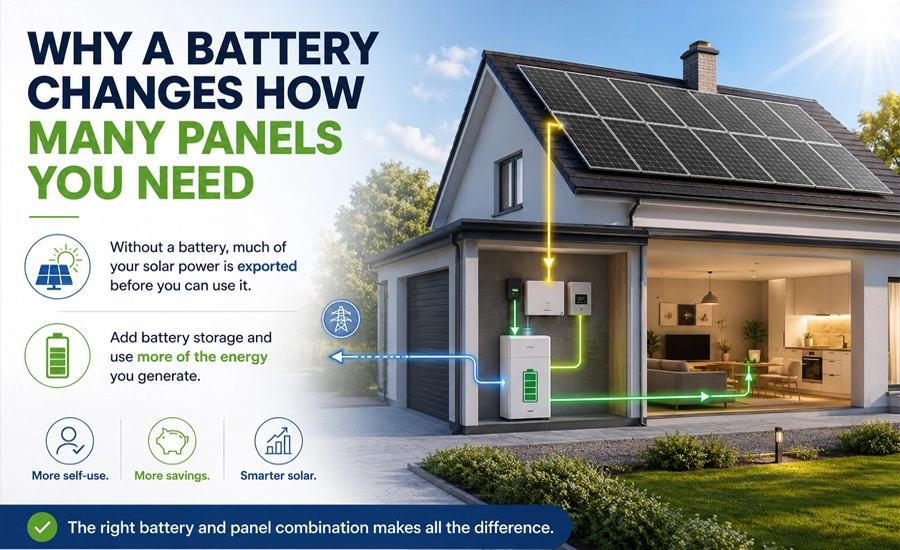
This trips a lot of people up. Without storage, you can only use solar as it’s generated and a typical home self-consumes just 30–50% of what the panels produce, exporting the rest. So, a big array without a battery often means giving away half your generation for a few pence.
With a battery, self-consumption rises to 70–85%, so a moderately sized array works far harder. That’s why our flagship package pairs 10 panels with 10.24 kWh of storage — the two are sized to complement each other, rather than fitting a huge array you can’t fully use.
Real-world examples
Average 3-bed family, ~3,200 kWh/year, no EV: ~10 panels (4.5–4.65 kWp) with a 10-kWh battery. Covers a large share of annual electricity. This is our Solar panel Fully Installed Package £7,995
Couple in a smaller home, ~2,200 kWh/year, out during the day: ~8 panels (3.5 kWp) with a battery to capture daytime surplus for evening use.
Family with an EV and/or high usage, ~5,000+ kWh/year: 13–14 panels (6 kWp) with a larger battery to feed the home and car.
So, how many solar panels do you need?
For most UK homes the honest answer is 8–14 panels, with the 10-panel, ~4.5 kWp band suiting the typical family home. But the only way to get it exactly right is to look at your actual usage and your actual roof. We model both before recommending anything — no guesswork, no overselling a bigger system than you’ll use.
Frequently asked questions
How many solar panels do I need for a 3-bedroom house in the UK?
Around 10 panels — roughly a 4.5 kWp system generating about 4,000 kWh a year — suits a typical 3-bed home using 2,700–3,500 kWh annually. With a battery, this covers a large share of the household’s electricity. Evergreen Power UK‘s £7,995 package is built around exactly this size.
How many solar panels do I need to power my whole house?
To generate as much electricity over a year as an average home uses, you’d need roughly 10–14 panels (4.5–6 kWp). However, matching generation to usage in real time requires a battery, since panels produce most power midday while much usage happens in the evening.
Do more panels always mean more savings?
Not necessarily. Without a battery, a typical home only uses 30–50% of its generation, exporting the rest cheaply. A right-sized array plus a battery usually beats a larger array alone — which is why panels and storage should be sized together.
Does roof direction affect how many panels I need?
Yes. South-facing roofs are most efficient; east and west-facing roofs produce around 80–85% as much, so you may add a panel or two to reach the same output. Shading also reduces output and is assessed during a survey.
Not sure what size you need?
Let Evergreen Power UK do the maths. As an MCS-certified installer accredited by HIES, TrustMark, NAPIT and ePVS, we’ll look at your real electricity usage and your actual roof, then recommend a right-sized system — never more than you’ll use.
Book a free solar assessment →
Written by: Kyler Walter

- Kyler Walter is a passionate advocate for renewable energy and sustainable living. As a leading voice at Evergreen Power UK, he specializes in solar energy solutions and has played a vital role in promoting innovative, eco-conscious technologies across the UK.
Latest entries
 SolarJuly 15, 2026Do Solar Panels Work in the UK? Yes – Here’s the Proof (2026 Guide)
 SolarJuly 1, 2026How Many Solar Panels Do I Need for My Home? (UK 2026 Guide)
 SolarJune 18, 2026How Much Do Solar Panels Cost in the UK 2026? A Clear, No-Nonsense Price Guide
 Solar BatteriesJune 2, 2026Tesla Powerwall 3: An Honest Look at Whether It’s Worth It for UK Homes in 2026
